
Assam GK Section
Soil Types of Assam
Compiled on 2026-01-18
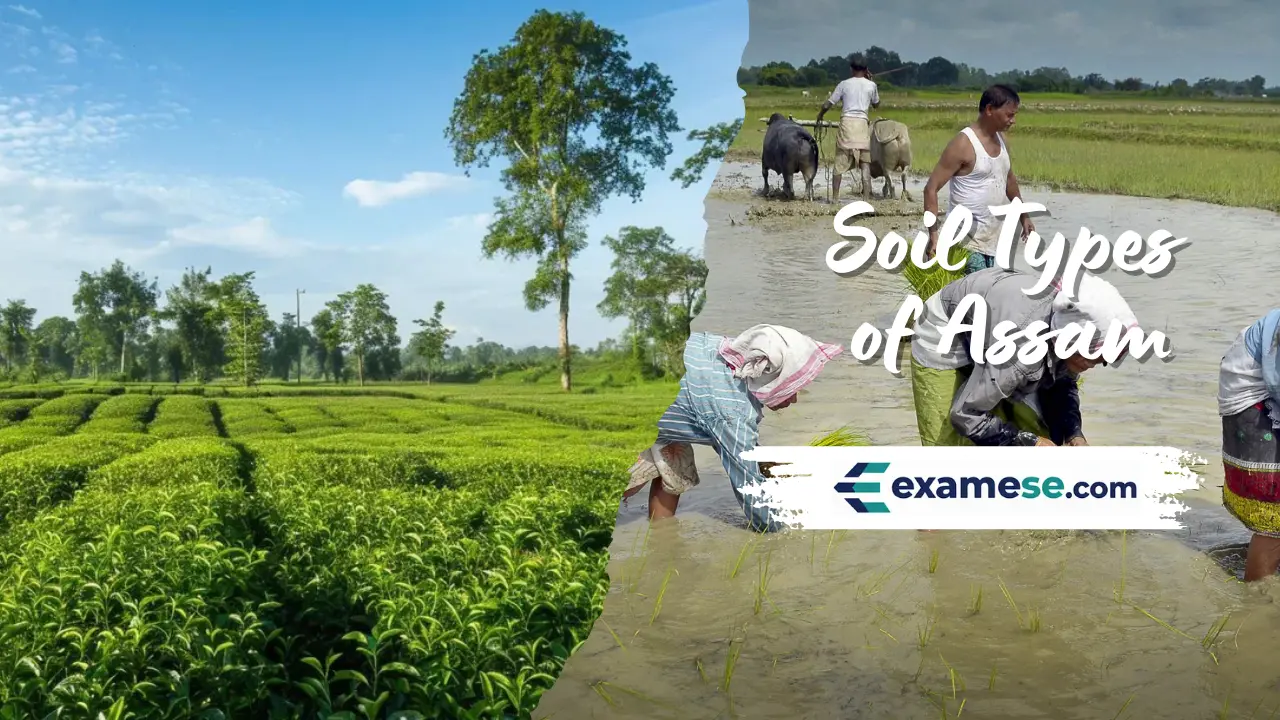
Assam's soils are nitrogen-rich yet erosion-prone, shaped by riverine alluvium, piedmont fans, hill slopes and lateritic plateaus.
Key pointers
- Alluvial soils dominate the Brahmaputra and Barak plains, support cereals, pulses, oilseeds and plantations, and include younger char-land deposits and older brown loams of upper Assam.
- Piedmont soils occupy the Himalayan foothill bhabar and tarai belts with unassorted detritus grading into saturated sandy-silty zones of tall grasses.
- Hill soils—red sandy and red loamy—line the Assam-Meghalaya border, Karbi plateau and Barail hills; they are deep, acidic and rich in organics but can lack phosphates and lime.
- Lateritic soils blanket North Cachar Hills, southern Karbi Anglong and patches near Golaghat and Barak plains, featuring dark heavy loams deficient in nitrogen, potash and lime.
- Soil erosion is severe: 6,116 hectares were recorded as lost in the Upper Brahmaputra and North Bank in 1994, and about 3.2 million hectares of plains are vulnerable to topsoil runoff, while 1.53 million hectares of hill slopes face mass-movement degradation.
Soil groups
Young alluvium
Sandy to silty loams, slightly acidic near riverbanks, low in phosphoric acid and humus
Old alluvium
Very deep brown to yellow fine-to-coarse loams, slightly to moderately acidic
Piedmont (Bhabar/Tarai) soils
Bhabar includes boulders, pebbles, sand and silt; tarai zones are sandy to silty loams that remain saturated
Hill soils
Red sandy soils are deep, well drained and organic-rich; red loamy soils are coarse, acidic and low in nitrogen, phosphoric acid and lime
Lateritic soils
Dark heavy loams deficient in key nutrients